Product before tooling
I start with the problem and the experience of the people who will use the solution.
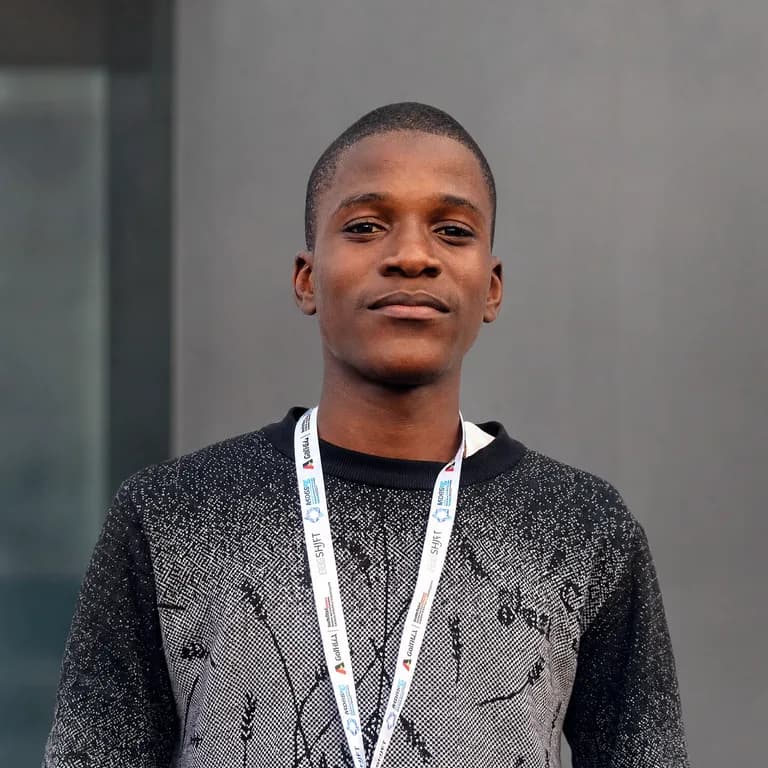
I build fast, accessible, user-centred web and mobile products with React, TypeScript and Next.js.
React · TypeScript · Next.js · React Native
I’m a Frontend Developer and software engineer based in Luanda. I specialize in React, TypeScript and Next.js, and I enjoy turning complex problems into clear, fast and useful interfaces.
My foundation in C and systems programming taught me to understand what happens beneath abstractions. In my projects, I combine that technical rigor with a strong focus on product, accessibility and performance.
“Good software is the intersection of solid fundamentals and relentless curiosity.”
I start with the problem and the experience of the people who will use the solution.
Readable code, explicit decisions and architecture proportional to the problem.
Performance, accessibility and interaction states treated as part of the product.
03 · SELECTED WORK
Three flagship projects, with the problem, architecture and technical decisions presented in a straightforward way.

GitHub Repository Intelligence
Transforms the structure of any repository into technical analysis and actionable next steps.
Useful repository data lives scattered across files, languages, commits and issues. The challenge was to bring that technical context together in a single analysis, without requiring cloning the project or opening multiple pages.
An Express backend queries the GitHub API and structures the repository context. The pipeline uses Gemini, with model selection and fallback via OpenRouter, to generate architecture analysis, visual graph, health radar and roadmap. The React frontend presents results in a single interface.
Analysis depth vs. response time: data collection is limited to highest-signal context and results can be reused when the repository doesn’t change, avoiding unnecessary calls and processing.
Smart Event & Guest Management
Guest lists, permissions and real-time check-in for in-person events.
Managing entries manually creates queues, incorrect access and little visibility over the event. The proposal is to centralize guests, RSVP, permissions and check-in operations in a fast experience for on-site teams.
React app with TypeScript and Tailwind, supported by Firebase. Authentication separates admin, client and operator profiles; Firestore syncs guests, states and metrics in real time; entry flow combines quick search and QR Code reading.
Operational speed vs. access control: the system prioritizes a straightforward interface for check-in, but maintains permissions and security rules on the backend so each profile only executes authorized actions.
Task Manager for Developers
Engineering productivity with Kanban, Markdown, shortcuts and GitHub Issues integration.
Generic task tools don’t track well with the development workflow: snippets, technical templates, keyboard navigation and issues live separately. This project brings those elements together in a single app.
React, TypeScript and Vite frontend, organized by features. Zustand maintains global state with local persistence; dnd-kit supports drag-and-drop Kanban; Markdown handles code snippets and GitHub integration imports public issues.
Rich functionality vs. simplicity of use: the app concentrates developer tools, but Command Palette and keyboard shortcuts keep the interface from feeling heavy day to day.
Mobile AI Creative Writing Assistant
A mobile space to turn creative blocks into verses, poems and lyrics.
Creative block happens before the first line. The app gives quick ideation suggestions without taking away the user’s control over their voice and writing direction.
React Native, TypeScript and Expo mobile app. Navigation, screens, services and contexts are separated to keep the codebase scalable. A service integrated with Gemini API processes prompts and delivers creative suggestions directly in the mobile experience.
Automation vs. authorship: AI is used as a starting point, not a replacement for the writer; suggestions are treated as editable material within the creative flow.
Premise Inversion Engine
Turns real problems into testable hypotheses and reproducible micro-experiments.
Finding alternatives to an established idea usually depends on subjective brainstorming. Contrafato formalizes the process: extracts core premises, inverts them in a controlled way, and converts the result into small, measurable experiments.
Next.js App Router frontend with React and Tailwind. Route Handlers at /api/contrafato orchestrate extraction, inversion, AI validation and scoring. Postgres persists hypotheses, experiments, metrics and logs; single-process async workers control parallelism.
Creativity vs. auditability: operators have linguistic fallback to not interrupt flow, but input, seed, operator versions and templates are persisted to allow identical replay and debugging.
Urban Mobility App
Mobility designed around real local context: neighborhoods, habits and references.
Mobility solutions often ignore neighborhoods, travel habits and local references. Kila was born to represent that context directly in the product.
Flutter and Dart mobile app, prepared for Android, with maps and routing as the core experience. A Node.js backend concentrates the routing logic and mobility data integration.
Feature coverage vs. performance on affordable devices: the mobile codebase prioritizes a smooth experience on mid-range and low-end devices, common in the local market.
Pet Adoption Platform
A clear, welcoming adoption experience centered on each animal.
Shelters do essential work, but confusing interfaces make it harder to discover animals and proceed with an application. The goal was to build an accessible and emotionally clear digital presence.
HTML, CSS and JavaScript project focused on frontend fundamentals. The structure presents animals and the adoption process through a responsive interface, without adding unnecessary technological complexity.
Simplicity vs. automation: the first version prioritizes performance, quick reading and easy maintenance; more complex integrations can be added when the adoption flow requires it.
TECHNOLOGIES AND PRACTICES
The technologies and practices I use to build clear, fast and maintainable products — without arbitrary proficiency bars.
My core area: robust, responsive and user-centred interfaces.
Cross-platform applications with attention to performance and interaction flow.
Integrations and pipelines supporting real product capabilities.
Technical foundations and care for the experience in every interface state.
// select a star to read its note
Open to full-time roles, collaborations and freelance work. Choose the most convenient way to start a conversation.